By Chu The Cud / October 25, 2026
There was a time when walking into a hospital meant one thing: You were there because you needed medical attention.
Not because you were a Republican. Not because you were a Democrat. Not because you supported Donald Trump, Joe Biden, or anyone else.
You were a patient. Period.
But something disturbing is happening in a profession that is supposed to place human life above personal prejudice.
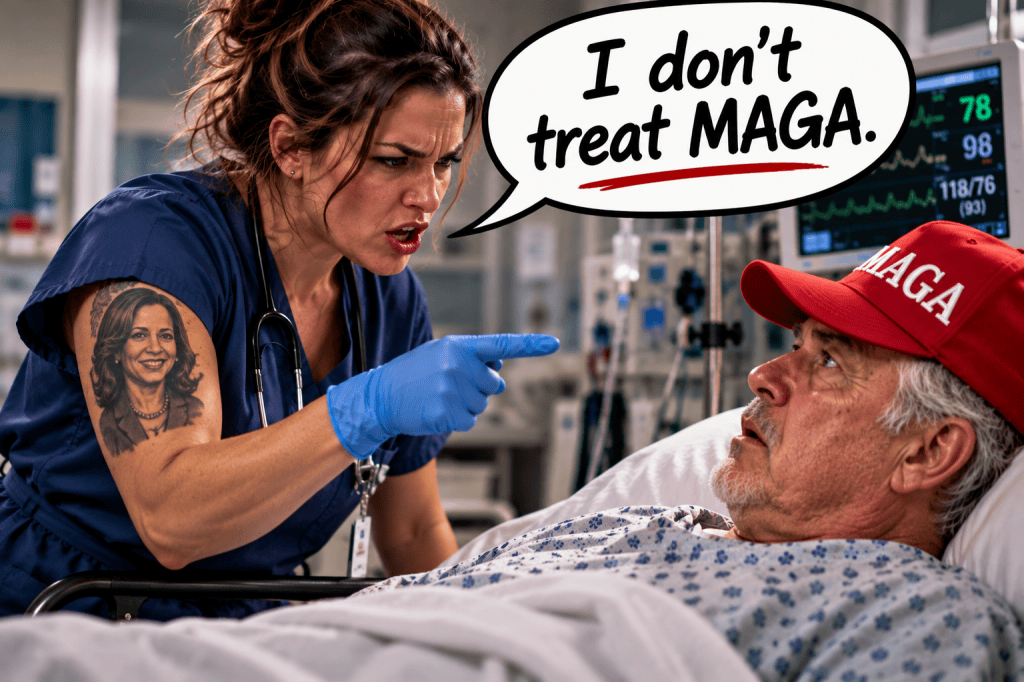
In Florida, a social media post attributed to nurse anesthetist Erik Martindale declared that he would refuse to administer anesthesia to MAGA supporters. Martindale subsequently claimed his accounts had been hacked. Regardless of who authored the statement, the controversy raised a serious question about political discrimination in healthcare.
Another Florida nurse, Lexie Lawler, was terminated after publicly wishing severe childbirth injuries upon White House Press Secretary Karoline Leavitt.
In Illinois, nurse practitioner Shawna Harris publicly suggested she would refuse to prescribe Viagra to white conservative men following the Supreme Court’s decision overturning Roe v. Wade. She subsequently resigned.
And in Virginia, a healthcare employee, Malinda Cook, lost her job after posting videos encouraging people to harm federal immigration agents.
These incidents are not identical. Some involved statements about withholding care, while others involved expressions of hostility or suggestions of violence. They do, however, raise a common concern about the judgment we expect from people entrusted with the well-being of others.
When did political disagreement become justification for wishing suffering upon another human being?
Healthcare professionals take on responsibilities that extend beyond their personal beliefs. Patients place their lives in the hands of people they often know nothing about.
They trust that the person administering anesthesia, prescribing medication, or monitoring their vital signs will exercise professional judgment without political prejudice.
That trust is fundamental.
And once that trust is compromised, what happens next?
Should patients begin asking their doctors which political party they support?
Should someone wearing a MAGA hat worry about receiving proper treatment?
Where does it end?
Political disagreement is nothing new in America. Neither is personal prejudice. But social media has given people a platform to broadcast hostility that once might have remained private.
And when that hostility comes from someone responsible for another person’s life, it deserves scrutiny.
We constantly hear about tolerance, inclusion, compassion, and equality.
Beautiful words.
But what do they mean when compassion is reserved for those who share our opinions?
What is tolerance if it disappears the moment someone votes differently?
And what is equality if access to care becomes conditional upon political allegiance?
The true measure of someone’s principles is not how they treat people they agree with, but how they treat those they don’t.
A healthcare professional has every right to hold political opinions. They have the right to vote, protest, criticize politicians, and participate in public debate.
But political convictions cannot become a substitute for professional ethics.
There is only a human heart.
The COVID-19 pandemic already left deep scars on the relationship between the public, the medical profession, and government institutions. Conflicting information, changing guidelines, political interference, and the weaponization of medical decisions left many Americans questioning whom they could trust.
That trust has yet to be fully restored.
And now, at a time when the medical profession should be rebuilding public confidence, we are witnessing healthcare professionals publicly expressing hostility toward people because of their political beliefs.
This isn’t simply a matter of political disagreement. It threatens the very foundation of trust upon which medicine depends.
A profession struggling to regain the public’s confidence cannot afford to give patients another reason to fear the people entrusted with their lives.
Perhaps the sickness we should be most concerned about isn’t the one that brought the patient into the hospital.
It’s the one we’ve allowed to infect our society.
— Chu The Cud
© 2026. All Rights Reserved.

