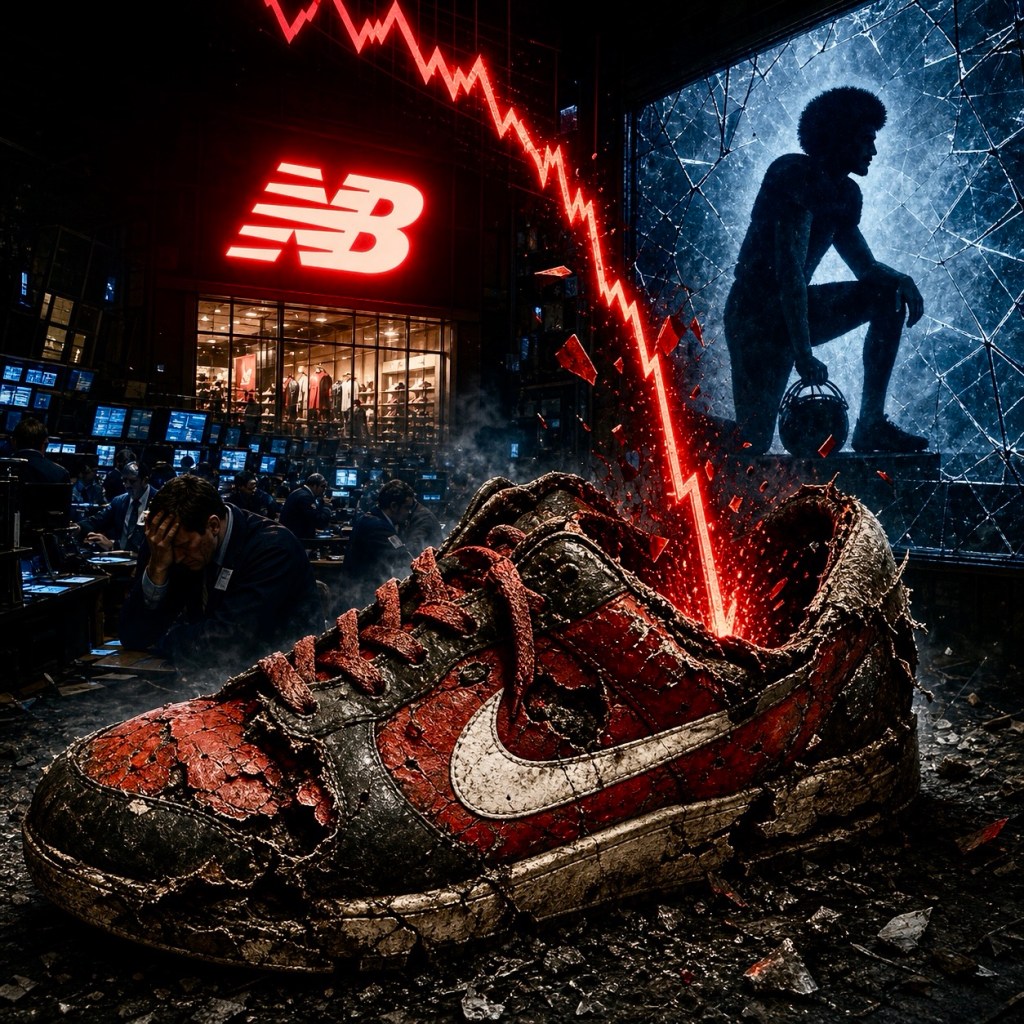
Nike Gets Booted From the S&P 100 After Losing Hundreds of Billions in Market Value.
Being removed from the S&P 100 is a significant warning sign, but it isn’t the same thing as being kicked out of the S&P 500.
Nike’s stock has suffered a massive decline from its 2021 peak.
Nike’s own 2026 annual report shows NKE down 63.55% over the five-year period through May 31, 2026, while the S&P 500 gained 93.80%.
Revenue peaked around $51.4 billion in fiscal 2024 before falling to $46.3 billion in 2025 and $46.4 billion in 2026.
Nike has faced stronger competition from brands such as Hoka, On and New Balance, weakness in China, and criticism of its product/retail strategy.
Sometimes a wound doesn’t heal and takes years to fester.
On the Colin Kaepernick controversy, Nike said:
“We would rather alienate some customers if it strengthens our relationship with younger, urban and culturally progressive consumers.”
Immediately after Nike announced Kaepernick as the face of its 2018 campaign, Morning Consult measured a dramatic deterioration in Nike’s favorability: its net favorability reportedly fell from +69 to +35. The backlash included people publicly destroying Nike merchandise and calls for boycotts.
Sometimes an injury doesn’t look serious when it happens. You walk away, the adrenaline wears off, and you think you’re fine.
Then, years later, you realize the injury never really healed.
That’s how I look at Nike and Colin Kaepernick.
I’m not arguing that Kaepernick immediately destroyed Nike. Quite the opposite, the campaign initially helped Nike. Sales went up, the brand received enormous attention, and Nike appeared to have made a very successful marketing decision.
But maybe we’re looking at the wrong timeline.
What if Kaepernick was the injury, not the immediate cause of death, but the beginning of a wound that Nike never recognized?
Nike had spent generations becoming one of the most recognizable brands in America. Then it took a very public political and cultural position.
Some consumers loved it.
Others didn’t.
And some of those people may have simply walked away.
The younger generation eventually moved toward newer brands like Hoka, On and New Balance. Meanwhile, some of the older generation who had grown up wearing Nike may have stopped identifying with the brand after Kaepernick, and never came back.
That’s the part we can’t easily measure.
You can’t look at a balance sheet and find a line that says:
“Customers we permanently alienated in 2018.”
But losing a customer isn’t always an immediate event. Sometimes it’s a slow leak.
A customer doesn’t boycott you. They simply buy something else next time.
Then again.
And again.
Until one day you look around and realize an entire generation has moved on.
So no, I wouldn’t say Colin Kaepernick “killed Nike.”
I’d say something more provocative:
Kaepernick may have given Nike an injury that didn’t look fatal at first, but over time, the wound may have contributed to the brand losing customers it never got back.
And perhaps Nike’s biggest mistake wasn’t taking a political position.
It was underestimating how long the consequences of that position might last.
c 2026 Chu The Cud
All Rights reserved.

