What’s the oldest thing you own that you still use daily?
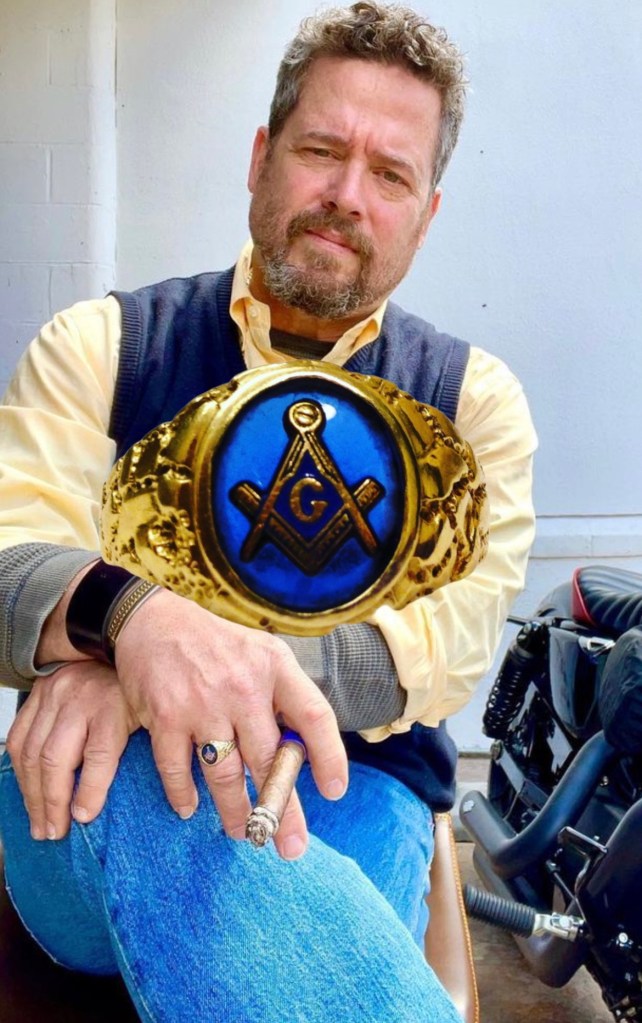
Assuming that it’s something that is not attached to my body or inside my body, I will say, my Master Mason ring.
When I became a Master Mason, July 2008, I couldn’t wait to get a Square and Compass ring. I purchased it from a Lodge Brother who was a Past Master from my lodge.
A seed is planted into the soil. The minerals and nutrients that saturated the earth produce the elements needed for the seed to grow. The sun’s heat and energy, warms the ground from the rain’s moisture to aid in the plants growth.
A potato is plucked from the soil, cleaned and placed on top of other potatoes. It eventually gets pushed over by the other potatoes being dropped onto the pile and rolls into a dark corner, all alone. Without the soil it grew in. The soil that nourished it and protected it. And in the absence of the sunshine that help sustained it.
Days later the potato begins to get soft and shriveled due to dehydration. It doesn’t look good for the potato, however it begins to sprout. The sprouts start pushing through the potatoes thick skin, becoming a life force in its own existence, growing everyday. The potato has now become the nourishment and protector of the sprouts and the potato’s existence continues through the flourishing sprouts.
Even though this potato was not shipped away with the others to be consumed and become fuel for human cells to grow and reproduce, it’s still found a way to continue to live and give back to life.
Is the potato more in-tune with being and philanthropy than humans?
What can we learn about the circle of life through a potato?
Life is Impermanent and we must be resilient and able to adapt to our ever changing environment, situations and world in order to continue to grow and cherish the preciousness and fragility of life. We must give back like the potato or perish as a society. Even in it’s hardship the potato was able to nourish the sprouts as it became that for which it once was.
I don’t have a favorite season because each one is special and great in its own right. Each one has its own ambience, smell, feel and memorable moments.
The quiet of a snow fall, the perfect combination of a sun’s warmth and the light breeze on a spring day, the sound of the waves smashing into each other in the summer and the fragrance of the falling autumn leaves are just a few of the highlights of the four seasons.
Each season can call up memories of being one in sync with each season’s complexity of life.
The recollection of walking through the moist slushy snow, the icy chill numbing your face as the warm vapor expels from your breath. The holiday lights and songs that encompass the yuletide season. Instantly feeling the cold when walking out from a warm place and the warmth on your face when going inside on a cold day.
Sitting on the ground in a park or yard and watching the bees jump from flower to flower while smelling all the plants and flowers coming to life. All the new bouquets of colors blooming after a few months of mostly, black, grey and white.
During the long days of summer, drinking from a garden hose on a hot day and tasting the warm temperature of the water changing smoothly to a cooler taste. The smell of freshly cut grass and the aroma of charcoal being lit and prepared for the summer cookouts. Yellows, greens and blues creating the scope of a summer day.
The swiftly changing tones of the shedding leaves from greens to beautiful hues of red, orange, and yellow and they cascaded down and blanket the ground. Picking a special pumpkin and carving it to put in a window for Halloween and later baking the seeds in the oven for a delicious treat. The smell of nutmeg and cinnamon cooking in the pies they encompass, baking in an oven for Thanksgiving Day.
Why must we categorize things in what is your favorite? Each has a place in the time of a memory along with a space in a heart. Each month of the season is unique in itself during a seasonal life. These four tapestries represent diversity and the cycle of life and are beautiful in their own distinctive moment in time.
I’ll sum it all up by committing to this, they’re all my favorite.
Luxury as defined by the dictionary is the state of great comfort and extravagant living. Expensive, elegant, beautiful. I believe this is the first thing that comes to many people’s minds when they hear the word, luxury. But is it really just that?
A luxury for many of us could be sleep. Working two jobs just to pay the most basic bills, putting a roof over one’s head and to have food in the refrigerator. The stress endured can affect one’s sleeping. A good nights sleep is a luxury to many.
Cellphones use to be a luxury decades ago but now have become a necessity and a nuisance. Many people can’t function without them. Even the homeless have them now.
Another luxury for some is transportation. However, it can be expensive to upkeep and purchase gasoline in order to get from point A to point B. Even though it’s much cheaper to use public transportation, most prefer to use their own.
Many others may say, high speed internet, cable tv, video games, cigars, Starbucks coffee, music, a fast sports car, motorcycle, travel, alcohol, weed, eating meals out, and so on.
I couldn’t nail it down to one because for me there are seven. Seven that I have become accustomed to and are taken for granted every day. They are a gift to most. The five senses plus two.
Seeing, hearing, smelling, tasting, touching and being able to move and communicate. These are the purest forms of luxury.
Without these seven, could you even truly enjoy any of the other luxuries in your life?
In the United States, we live in a secular republic where prayer was removed from public schools to accommodate non-believers.
This decision aligns with the First Amendment of the U.S. Constitution, which establishes the separation of church and state, stating that no law shall respect the establishment of religion or prohibit its free exercise. Interpretations of this amendment vary based on individual perspectives.
In the 1960s, the U.S. Supreme Court banned school-sponsored prayer in public schools in Engel v. Vitale, citing that it would violate the First Amendment.
Students are allowed to meet and pray on school grounds, provided they do so privately and do not pressure others to participate. However, teachers promoting religion and prayer during class can face disciplinary action.
In recent times, there has been a growing acceptance of educators promoting various sexual ideologies and identities in classrooms, even when parents express objections and concerns about exposing their children to such topics.
This raises questions about consistency in applying the same legal standards.
Government officials, politicians, and mainstream media outlets often criticize parents and children who believe schools should not promote sexual promiscuity, while prayer remains prohibited.
This perceived hypocrisy suggests that personal beliefs and opinions are being advanced in schools without the same scrutiny faced by religious practices.
Parents have the right to raise their children according to their values and provide them with the tools they need to succeed in society.
They also have the right to advocate against what they consider inappropriate for their young children.
Shouldn’t the same standards apply equally to both religious and sexual education in schools?
If we didn’t think about life after death, it could have a profound impact on our consciousness and the way we experience life.
Anxiety comes into consciousness when very young children are introduced to the folklore of Santa Clause. Santa is a legendary figure who brings gifts to well-behaved children and coal to naughty children during the Christmas season. It is the first time we start to feel anxiety about a fictitious situation and to self monitor our behavior for presents.
The next contrivance to bring anxiety to our consciousness as young children is religion and the afterlife.
The afterlife is introduced to us from our earliest days. It becomes the first idea implemented into our brain to condition us to feel anxiety and modify our behavior.
Even though these fables appear irrational and without facts, we have been conditioned from our earliest recollection to trust that it happened and is true.
We don’t know what happens after death for the reason that there isn’t any case of anyone coming back after death to explain it.
However, there are millions of people following faith without facts. Just superstition with a hint of imagination.
At one time, the mythology of the Greek Gods ruled the faith of the people. Great stories but as fact, they were and still are improbable.
Rather than worrying about the after life, just live and enjoy your life. When the electricity ceases in your body, you’ll discover what’s next or maybe not.
Two people, the same race, size, gender, religious ideology and neighborhood are put into a set of circumstances. Will the outcome be the same or different?
Choosing to walk down a dark, dank dirty alley late at night is a choice. The outcome whether positive or negative is based on that choice.
With todays groupthink attitude, people forgot how to take responsibility for their actions and rather find it easier to use that victim card to base their actions on. They blame it on their environmental culture along with other various scenarios other than themselves.
These types of people want society and culture to change for them, rather than better themselves to fit in with society. Does the spectrum for mental illness need to be that encompassing?
To be introspective first never occurs to them as it is never an easy road to look inward at oneself and battle with your ego. Just blame it on anything other than themselves. Blame it on past transgressions and then find that collective of people to fight that cause and be labeled courageous. However, growth to be better never ensues.
Choosing not to look inward could be due to laziness, fear of the unknown, being uncomfortable with what will be uncovered. Or could it be something else?
Wouldn’t it be easier to work on oneself first? Uncovering why they continue to behave in a certain way that is detrimental to themselves. The outcome of working on oneself could definitely create fulfillment and provide a positive outlook and longevity in one’s life. It requires discipline.
The answers are right at their fingertips if they choose to find out. All depends on what hypnotic social media sites one choose to waste their time on.
Every person is unique in their own right and should be respected. Unique in their characteristics, perspectives, and capabilities and these can lead to different responses and outcomes even in similar circumstances.
Personal motivations, efforts, values, abilities, support networks, and previous experiences can all shape an individual’s response to a given situation which can determine their future outcome.
Thoughts, beliefs, actions and perspectives play a powerful and significant role in determining one’s emotional well-being and will play an integral part in guiding their destiny.
Positive thoughts, emotions and actions will be constructive and beneficial in one’s life while negativity in thoughts, emotional reactions and actions will be detrimental and destructive, intensifying their unhappiness and is unhealthy over all.
The world is witnessing the mentality and philosophy of nationalism incorporated into smaller groups like LBGTQ, black life matters, feminism, progressives, the every changing political affiliations of donkeys and elephants and religious identities. Nothing else matters but the sovereignty and longevity of that groupthink and its hypocrisy of tolerance.
To step back and look at the larger essence becomes lost with, hypothetical propaganda messaging of victimization. It’s done to continue the incoming money flow to the perpetrators pushing the groupthink directive and mind washing the believers to volunteer for the good of the cause.
Collectivist mislead their minions with biased and distorted science and facts which becomes fodder for those pushing their disinformation. Some followers of the collectivism become confabulated.
The action of self censoring to conform for self preservation trumps ethical considerations after witnessing what happens to the dissenters of the collectivist philosophy.
In military strategy, dividing and conquering involves breaking the enemy’s forces into smaller groups and attacking them individually, rather than facing them as a unified front. By pitting groups against each other, those in power can manipulate the situation to maintain their authority and power.
By creating smaller groups and pitting them against each other, stagnation, inefficiency, or lack of progress within a society ensues. Lack of social cohesion and collaboration will continue to impede progress and exacerbate societal problems.
The banter of open dialogue, diversity of thought and constructive criticism becomes irrelevant and screaming the groupthink’s ideological rhetoric at each other creates missed opportunities to make things better for all involved.
When all is said and done, it’s all about continuing the flow of money and influence of power to these fraudulent organizations at the cost of people.






 Chu The Cud