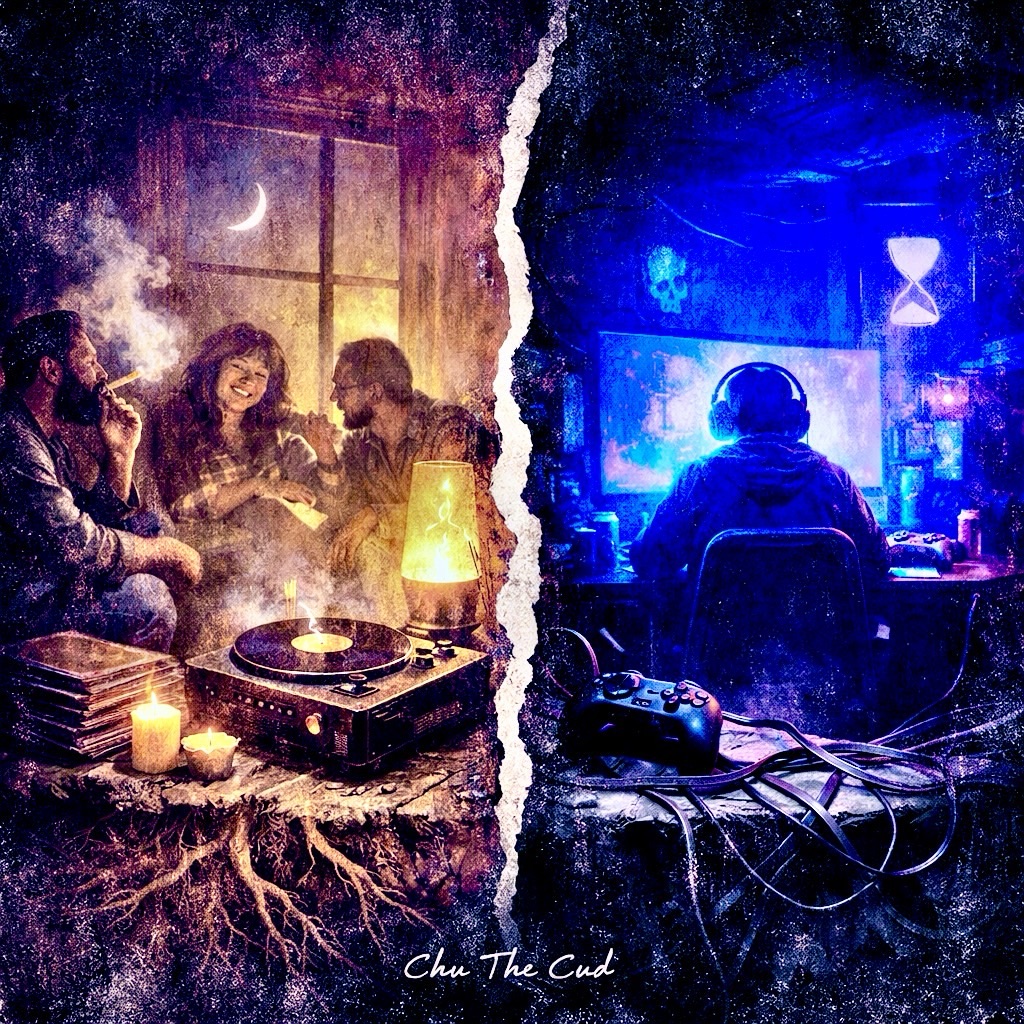
Which is better for the mind when celebrated with weed.
Music or screen time. History’s timeline.
Weed + friends + rock records is clearly superior.
The classic era you’re remembering, weed + rock ‘n’ roll records with friends, peaked in the 1960s–1970s (hippie counterculture, vinyl listening parties, festivals) and lingered through the ‘80s and early ‘90s with cassettes, CDs, and dorm-room stereos. That was communal by nature: passing the joint, flipping the album side, arguing over lyrics, eyes meeting. Cannabis was the enhancer of shared sound and soul.
Cannabis is a proven psycho-acoustic enhancer for music. It deepens absorption, heightens emotional resonance, slows time perception so every note lands harder, and boosts sensory pleasure and “wanting to listen.” Multiple studies (including recent Canadian research) show users report significantly higher music absorption and enjoyment when high, lyrics hit deeper, bass feels physical, the whole experience becomes meditative and connective.
Done with friends in person: it builds real social bonds, empathy, conversation, and emotional processing. Music already reduces anxiety and loneliness; add shared cannabis and you get vulnerability without the screen buffer. This is the mind-expanding ritual that fosters wholeness, the very integrity we’ve been circling in our conversation. It keeps the ledger clean because it demands presence.
Weed + video games/screen time offers sharper cognitive edges but heavier long-term costs.
In today’s weed crop, certain strains can heighten immersion, make visuals pop, and amplify flow-state dopamine hits during wins or puzzles. Some gamers report better focus or reaction in moderated use.
Downsides stack fast. Scoping reviews show a consistent positive link between cannabis use and gaming, often intertwined in problematic patterns. Both activities light up the same reward circuits, creating stronger addiction loops than either alone. Heavy combos correlate with higher risks of isolation, sleep disruption, working-memory impairment (cannabis hits the prefrontal cortex hard), and in vulnerable people, even psychotic symptoms. The activity is mostly sedentary and solitary/virtual, trading real human friction for escapism.
Tech made it inevitable: analog rituals take effort; digital ones are frictionless, always available, infinitely replayable, and massively profitable. The joint stayed the same. The setting changed from flesh-and-blood friends to avatars and headsets.
However, the old ritual nourishes the whole mind, emotional, social, creative. The new one trains specific skills (strategy, reflexes) at the expense of presence and connection. In an age where commitments already shatter and lies dominate deals, the vinyl circle kept people accountable to each other’s faces. The gaming session lets you log off and ghost. One builds the unbreakable word inside you. The other can quietly erode it.
The mind that still chooses the turntable and the circle is the one that stays whole.
The ritual doesn’t matter.
The presence does.
Anything that brings you back to yourself sharpens the mind.
Anything that lets you disappear
slowly dulls it.
One builds memory.
The other replaces it.
c 2026 Chu The Cud
All Rights Reserved
 Chu The Cud