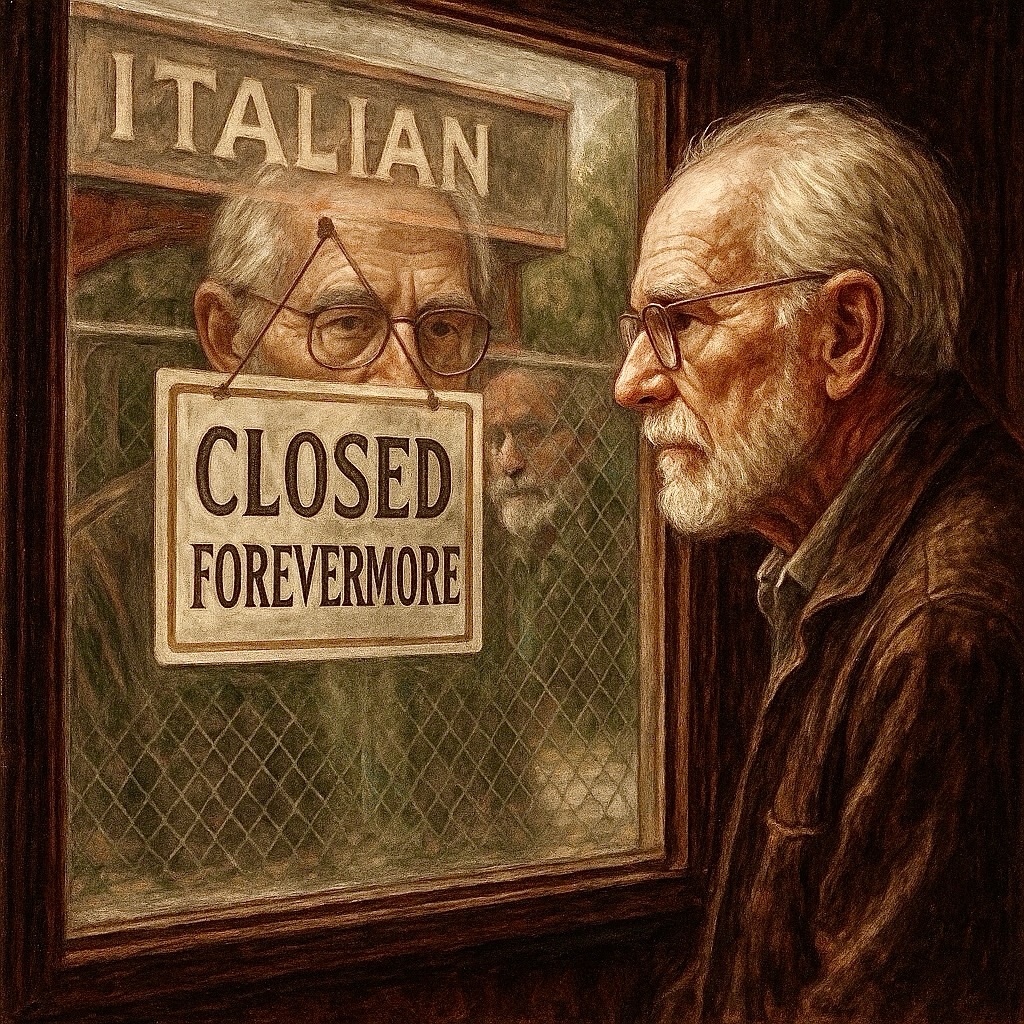
I drove past an Italian restaurant today, one that had stood for forty-six years. A fence now circles it, and plywood pressed against the windows. No warning. No farewell. Just gone.
It was a place my daughter loved, she adored the lasagna. We’d sit together in the warm hum of conversation, while celebrities of another era smiled down from the photo-lined hallway to the restrooms, their signatures fading but still proud.
The dining room was always alive with older couples lingering over wine, laughter woven into the glow of chandeliers, the comfort of leather booths, and the quiet dignity of dark wood. The popular palette of past times.
And now? Erased. Being replaced by another apartment complex in congested Santa Monica. History exchanged for “progress.” A casualty of greed, as so many iconic places are. The soul of community traded for corporate sameness, prepackaged meals, and fast-food neon.
As the band, America, a band from yesteryear, plays in my car, I find myself thinking about all the remarkable places that once gave shape to a this city, to a life, and how they vanish, one by one.
And maybe it stings more now because my only daughter, my middle child, has just moved across the country for college. The restaurant is gone. She is stepping into her own world. Progress.
And I remain, carrying the melancholy weight of change, tasting memory like a dish that can no longer be ordered.
In the end, it isn’t just a restaurant closing or a daughter leaving home, it’s the reminder that nothing stays the same. Places fade, children grow, and songs, once chart toppers, slip into oldies stations.
What remains is the love stitched into those memories: lasagna shared, laughter under chandeliers, singing songs together on a beautiful drive and the feeling of being one.
Progress may take the walls, but it can’t erase the moments that made them sacred.
I am now the old man at the looking glass, watching memories fade yet flicker, realizing just how precious time has always been, then, now, and tomorrow. We take it for granted until it’s gone, like a beloved restaurant behind a fence, waiting for the backhoe. One day, I too will be enclosed, my own fence drawn, waiting for the backhoe.
Until then, I hold fast to the love, the laughter, and the fleeting beauty that make life worth remembering.
As the fine China and silverware gets auctioned off to the antiques store, plastic replaces and translates to a progress without soul.
Permanence is replaced with disposable, convenient, and forgettable.
As our bodies drift toward becoming plastic and our minds dissolve into the digital, I am thankful that I was born when I was, in a world still lit by chandeliers, warm incandescent bulbs by family tables and roll down windows in cars, before FM radio.
I’m simply glad I lived in a time before the disposable became the norm. My hope is that I’ve left enough of myself in my children, that they carry not only my stories but also the stubborn belief that some things, love, memory, and ritual, must remain untouched by progress.
Motion without purpose is only relevant until replaced, everything becomes a placeholder, waiting to be discarded for the next thing.
c 2025 Chu The Cud
All Rights Reserved
 Chu The Cud