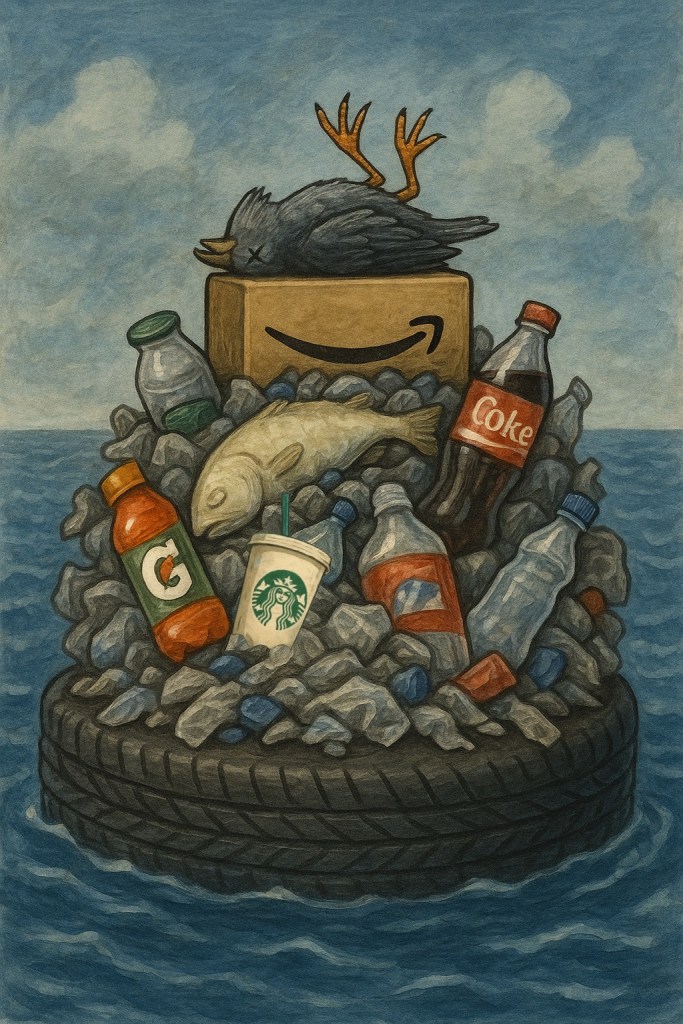
It’s a strange irony of our time that many of the loudest voices warning about climate catastrophe are also the most active participants in the very consumer culture driving it.
These are the same individuals who protest tariffs on China, arguing that restricting trade hurts the global economy, while overlooking that much of what flows from China are cheaply made, plastic-heavy goods produced in factories with little regard for labor rights or environmental impact. They oppose protectionist policies not because they support ethical production, but because they don’t want to pay more for their next phone case, water bottle, or novelty gadget.
These are also the people who pushed hard for banning plastic straws. And yet they sip their oat milk lattes from plastic lids, in plastic cups, with plastic sleeves, while scrolling through Amazon on a plastic phone, ordering plastic-wrapped products shipped from 6,000 miles away, often made by workers with no labor protections, in regions with little to no environmental oversight.
The packaging alone is a landfill in transit: a plastic product, wrapped in more plastic, sealed in a plastic bag, stuffed into a cardboard box with plastic bubble wrap, then trucked to their doorstep by the millions, daily.
And when President Trump suggested we reduce reliance on Chinese imports—that perhaps we don’t need to ship over pallets of plastic toys, gadgets, and synthetic clutter, they scoffed. They dismissed it as isolationist, nationalist, even racist. But they never answered the environmental question:
Why are we importing pollution disguised as products?
What makes this worse is the refusal among many of these same voices to support policies that would rebuild American manufacturing, policies that could produce goods under far stricter environmental and labor standards than China or other nations. Instead, they champion globalism, cheap labor, and just-in-time convenience, all while claiming the moral high ground of climate advocacy.
What we’re witnessing isn’t just hypocrisy. It’s a kind of doublethink: the ability to hold two contradictory beliefs at once, that climate change is an existential threat, and that convenience must not be sacrificed in the fight against it.
So yes, ban the straw if you must. But until the conversation includes the Amazon box, the overseas factory, and the economic policies that made all of this normal, your activism is less about the environment and more about optics.
And optics, as we’ve learned, don’t clean oceans.
Glass is 100% recyclable and doesn’t degrade in quality. Plastic? Not so much. Now, decades later, we’re rethinking those “convenient” choices in the face of massive plastic pollution.
Now, decades later, we’re drowning in the stuff. Plastic in the oceans. Plastic in the landfills. Microplastics in our blood, our lungs, our food. Meanwhile, glass bottles, infinitely recyclable and chemically stable, are seen as luxury items.
Funny how saving the planet always seems to stop just short of personal inconvenience.
We didn’t evolve.
We just got lazier.
And wrapped it in activism.
c 2025 Chu The Cud
All Rights Reserved
 Chu The Cud
EPIC!!! Beautifully put together!!! Plastic boobs, butts, lips….fake society.
LikeLiked by 1 person
😂
LikeLike